

There’s a particular stillness that follows the word cancer in a certain setting.
It doesn’t matter where you are—at work, in a grocery store parking lot, in the middle of stirring dinner on the stove.
Once it’s said out loud by a doctor, or typed into a pathology report you weren’t supposed to read ahead of your appointment, something stops. Sound bends. Breath catches.
But almost always, the story begins in a doctor’s office.
Also Read: CT Scans: What They Examine and Costs
In the United States, breast cancer remains the most commonly diagnosed cancer among women. Despite decades of awareness campaigns, celebrity survivors, and millions raised in research funding, a diagnosis still lands with the same elemental force. But what comes after the diagnosis—the journey—can be just as harrowing. Because the real challenge isn’t just the illness. It’s the system built around it.
The Maze We Call Modern Medicine
Imagine this: You find a lump. You go for a mammogram. Then a targeted ultrasound. Then a biopsy.
Each test opens a new door, each room filled with its own specialists, paperwork, and uncertain glances. You try to keep the names straight: ductal carcinoma in situ, triple-negative, HER2-positive, Stage 1. You try to focus on survival, but your brain is now toggling between life expectancy charts and your health insurance portal.
It’s hard to square the promise of medical innovation with the fractured, unpredictable process so many patients endure just to access it. There’s no single building where it all happens. There’s no one doctor guiding the journey. And there’s certainly no clear answer when the question becomes: How much will this cost me?
The Emotional Economics of Cancer
We often talk about the science of breast cancer.
What’s less discussed are the quieter calculations patients make behind closed doors—what economists might call the “opportunity costs” of staying alive.
Can I afford to take time off work for surgery? Can I find someone to watch the kids during radiation treatments? What will I say to my manager if chemo makes me too sick to show up? What happens if my deductible resets in January and I’m still mid-treatment?
Curaechoice Case Study: Blood Pressure Medication Costs

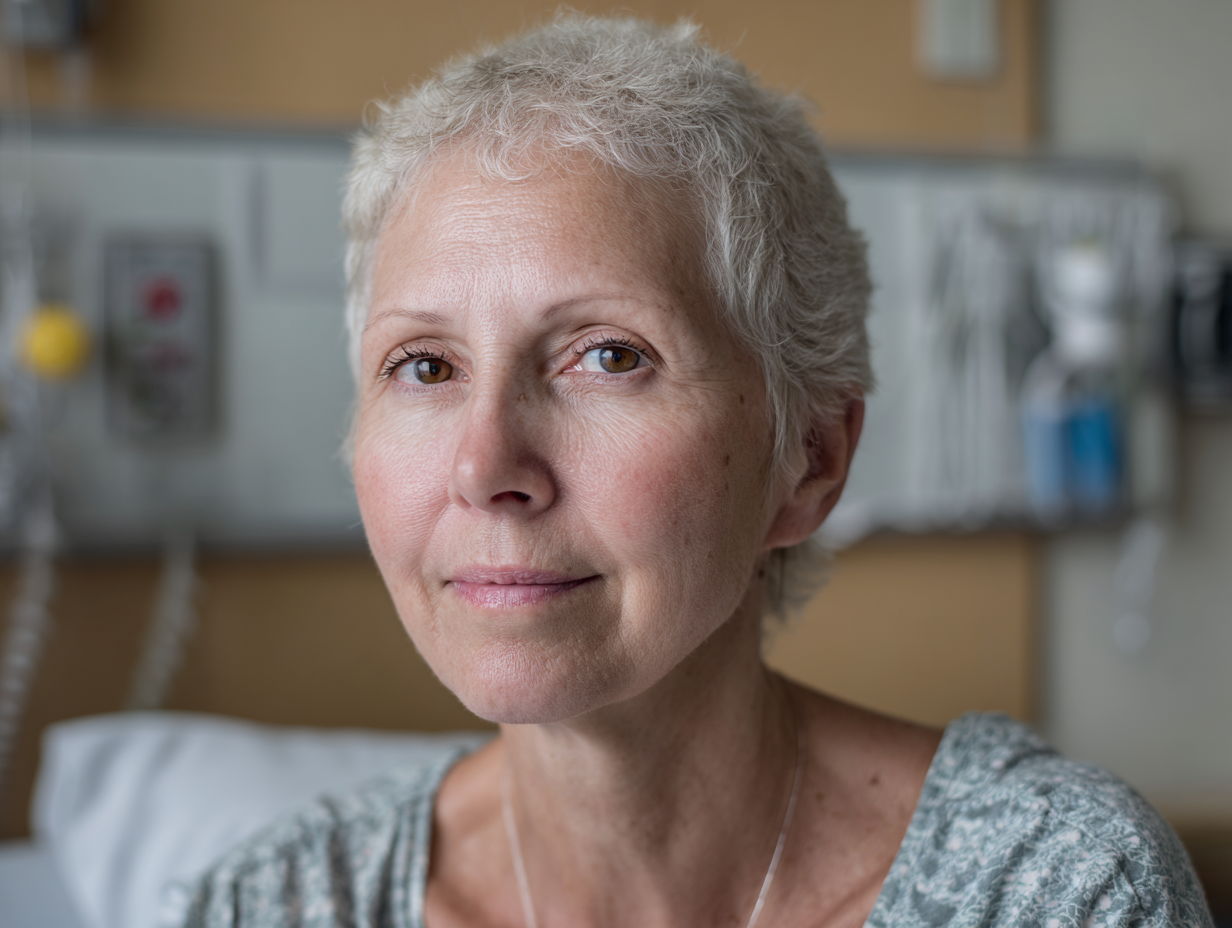
A woman sits quietly in her hospital bed, reflecting on the weight of survival beyond treatment.
Patients have often described spending weeks after diagnosis just trying to decipher her insurance policy—what would be covered, what wouldn’t, which oncologists were in-network, and which would trigger financial ruin.
The True Cost of Care
It’s a strange paradox of American medicine: we have some of the most advanced cancer treatments in the world, and some of the least accessible ones. Surgical procedures—whether a lumpectomy or double mastectomy—can cost tens of thousands. Add reconstruction, and it’s more. Chemo and radiation? Thousands more. Even the pre-treatment steps—genetic testing, MRIs, second opinions—come with price tags that, for many, are out of reach.
But the real cost isn’t just monetary. It’s the psychological tax of wondering, every time your phone buzzes with a medical portal notification, whether it's a new lab result or a five-figure bill. It’s the grief that shows up not just for your body, but for your financial future.
One Platform, Four Ways Forward: How Curaechoice is Rewriting the Script
Enter Curaechoice—think of it as a structural shift in how breast cancer care is delivered and funded for employees of self-insured companies.
Curaechoice doesn’t just offer better coverage. It eliminates cost barriers altogether. And it does it in four quietly revolutionary ways:
Zero Cost at the Point of Care. From the first abnormal mammogram to the final follow-up scan, patients pay nothing. No deductibles. No co-pays. No pharmacy markups. Surgery, chemo, radiation, genetic counseling, mental health support—it’s all covered.
Built-In Mental Health and Supportive Services.Where traditional plans treat mental health as an add-on (if they cover it at all), Curaechoice builds it into the cancer journey. Therapy, support groups, post-surgical physical rehab—all are included. Because healing isn’t linear, and it isn’t just physical.

No Surprise Billing, Ever. That creeping dread of an envelope arriving after your fourth treatment session? Gone. With Curaechoice, there’s no “cost sharing,” no hidden facility fees, no out-of-network penalty clauses. What you see is what you get: a full cancer care pathway, entirely without cost.
Member Spotlight: Wendy’s Story
When Wendy was diagnosed with DCIS at age 59, she and her husband—an employee of Mercedes-Benz—were just coming to terms with what that would mean for their family, both emotionally and financially. “Curaechoice came into our lives right when we needed it most,” she recalls. Self-employed and facing a double mastectomy, Wendy feared the financial toll would be as overwhelming as the diagnosis itself.
But with Curaechoice, that fear lifted. “I didn’t have to think about copays, deductibles, or whether I could afford the next appointment,” she says. “I could just focus on healing.”
Wendy was also deeply moved by the consistent, compassionate support she received from her Curaechoice representative. “She’s been with me through everything—always just a phone call away.”
Because Curaechoice also covered treatments for possibly related issues such as sleep apnea and acid reflux at no cost, Wendy experienced full-spectrum care without the usual billing anxiety. “They took care of everything. It made an impossible situation manageable.”
Today, Wendy reflects on her breast cancer journey with gratitude, not just for her recovery—but for the peace of mind Curaechoice made possible.
“Curaechoice made an impossible situation manageable. Their support allowed me to focus on my health, not the bills.”
It’s hard to quantify what that means—to make choices about care based on need, not cost. But patients who have Curaechoice don’t just start treatment faster. They’re more likely to complete it. They’re more likely to follow up, to access mental health support, to attend physical therapy, to avoid complications that come from deferring necessary interventions.
When cost is no longer part of the equation, people show up. And when people show up early, outcomes improve.
What Employers Get Right About Curaechoice
For companies, the math also works. Self-insured employers who offer Curaechoice aren’t just improving lives—they’re reducing avoidable costs. Employees who catch cancer early need less invasive treatment. They return to work faster. They’re more loyal, more engaged, more secure. And they spread the word—because word-of-mouth still matters in the emotional terrain of cancer care.
In industries with high turnover and rising healthcare costs, offering Curaechoice isn’t just compassionate. It’s strategic.
Beyond Treatment: A New Philosophy of Care
Curaechoice doesn’t just plug holes in a broken system. It rebuilds the system with patients in mind. That means your MRI doesn’t come with a billing code surprise. That your pharmacy doesn’t call to ask which card you’ll be using. That your counselor isn’t a third-party referral—you can speak with them within days.

It’s not concierge care for the privileged. It’s smart, efficient, human-centered care for workers—because that’s what they deserve.
What to Do If You or a Loved One Is Diagnosed
- If you're part of a company offering Curaechoice, the process is simple:
- You have access to the right providers at the right time.
- Scheduling is easier and paper work is non-existent.
- You receive care with no out-of-pocket cost.
- Support continues through recovery and beyond.
- No paperwork maze. No prior-auth headaches. No last-minute calls from billing departments.
Breast cancer doesn’t wait. It doesn’t care about job schedules, deductibles, or networks. But it does respond to early detection. To timely intervention. Curaechoice makes it possible to say yes—to treatment, to support—without fear of financial fallout.